

All about competition knives
Competition knife requirements. Rules, disciplines, and throwing techniques.

All about competition knives
Competition knife requirements. Rules, disciplines, and throwing techniques.
Throwing Knives Requirements
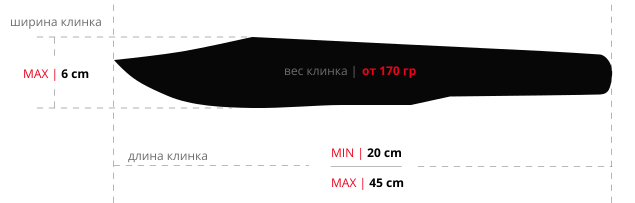
The weights and parameters of the projectiles listed below are intended for competition in the following disciplines: wolf back, long distance, silhouette, duel, mountain hunter, nine targets and speed throwing.
Rules for handling the projectile
Throwing knives are sporting equipment, and improper use can lead to dangerous situations. Therefore, the following rules must be strictly observed:
- The use of sharpened knives is strictly prohibited during both training and competitions.
- All projectiles must be aimed exclusively at the target or the ground when thrown. Aiming them in any other direction, even jokingly, is strictly prohibited.
- Unless otherwise stated, knives must be retrieved by all throwers simultaneously. The person picking up the knives must ensure that others on the throwing line are not completing their throws; otherwise, they must wait. Lost knives may be retrieved if doing so does not cause excessive delay.
- It is the responsibility of all competitors to help find knives lost by other participants.
- The use of closed shoes is mandatory; sandals or similar footwear are strictly prohibited.
- It is strictly forbidden to run with knives in your hands.
- During registration, each participant must sign a statement confirming that he/she has read and accepts these rules.
- Maintaining cleanliness and order on the competition site is a matter of responsibility and good manners for everyone. Everyone is required to clean up any litter they produce.
- All participants are required to handle the equipment and structures located on the competition site with care.
- All participants are required to report any equipment malfunctions or violations of these rules to the Manager.
- Maintain correct behavior, both physical and verbal.
- Be dressed in sportswear appropriate for the activity and in keeping with the surroundings of the venue.
- Maintain utmost respect for safety regulations and equipment.
- Be responsible for any damage caused by himself or his guests to the facilities and equipment.
- Hand over any throwing projectiles or other objects found on the throwing area to the person responsible for the area.
*Marking personal belongings with inscriptions, colors, signs or symbols will facilitate their return to the rightful owner. - Smoking should be done in a manner that is reasonable and does not create situations that cause anxiety or danger.
- Remember that knives are potentially very dangerous tools when used in an altered mental state. Inappropriate behavior on the throwing line will result in immediate disqualification and expulsion from the competition without warning. Therefore, only moderate alcohol consumption is permitted. Also, please note that insurance will not cover damages to the injured party if it is discovered that the person causing the accident was drinking alcohol or using drugs. Persons who violate this prohibition assume all subsequent costs of any incident, absolving the organizers of any liability.
- The use of illegal drugs is strictly prohibited both on the competition site and on the host site.

Disciplines in competitions
All competitions (local, national and international) using the FMNT logo strictly apply these rules.
- Walk-back is a discipline that awards the title of national/international/world champion in knife and axe throwing at officially recognized competitions of the appropriate level.
*The rules are the same for the axe wolf-back, the knife wolf-back, and the no-spin walk-back. - Three identical pieces of equipment are used, previously checked and approved by the competition judge.
- Throwing is carried out from distances of 3, 4, 5, 6 and 7 meters.
- Thrown projectiles must complete at least half a rotation before hitting the target (except, of course, in the no-spin style).
- They start from a 3-meter line and throw all 3 projectiles at the target from left to right.
- After this series of 3 throws, the points for each throw are recorded by an assistant, who is usually called a "scorer".
- After this, the thrower can collect the projectiles and move on to the next distance.
- This procedure is repeated for each distance up to 7 meters and is called a "walk." Thus, each "walk" will consist of 15 throws (3 at each of the 5 distances).
- After completing the "walk", the thrower returns to the 3 meter line and repeats the same procedure until 4 "walks" are completed.
- The competition consists of 4 "walks", a total of 60 throws.
- For each individual throw, points are awarded for the sector into which the projectile hits: from 5 points for the center and decreasing to 1 point for the outer sector of the target.
- If a projectile crosses the line between two sectors, the higher score is awarded.
- To score, the projectile must be embedded in the target. The visible part of the projectile, in contact with the target's surface, determines the number of points scored.
- If the projectile does not land or lands outside the points area, 0 points are awarded.
- The thrower must keep both feet behind the throwing line. If the thrower touches the line with their foot or crosses it (touching the ground behind the line with their foot) before the projectile hits the target, the throw is invalidated and scores 0 points.
- The thrower may move back from the throwing line, but must keep at least one foot completely within the sector between his distance line and the next.
- If your front foot touches the line of the next sector, the throw is cancelled and 0 points are awarded. Your front foot must not touch the line of the next, longer distance.
- The maximum number of points that can be scored in one “walk” is 75, which means 300 points in total.
- In the event of a disagreement between the thrower and the scorer regarding the points scored, a referee will be called in, whose decision is final and not subject to appeal.
- Medals will be awarded in categories regardless of the number of participants.
- Long Distance - A throwing competition involves throwing a projectile into a circular target with a diameter of 1 meter from the maximum possible distance.
*The rules are the same for the axe wolf-back, the knife wolf-back, and the no-spin walk-back. - The throwing area is divided into 3-metre sections, starting at 4 metres for the no-spin style and at 7 metres for the axe and knife (rotational style).
- The thrower, having chosen the initial distance within the first sector, has 3 throws at his disposal (test throws are not allowed).
- If one of the throws is successful (the projectile hits the target), the distance is measured to the nearest centimeter. The thrower then collects the projectiles and has three more throws for the next chosen distance.
- The thrower may choose a new distance by moving back any distance from the previous successful distance. They are not required to move to the next sector, but they cannot skip a sector.
- If the thrower misses all 3 throws at the chosen distance, the test ends for him.
- The weight and dimensions of the equipment MUST comply with the general rules of the competition.
- Medals will be awarded in categories regardless of the number of participants.
